
Church History: Books of the Month
April 2026
Monthly Updates on Recent Books in the History of Christianity
To raise awareness of recent books in the history of Christianity, the editorial staff of Church History: Studies in Christianity and Culture highlights each month a list of 10-15 books in diverse periods and geographical regions that we hope will be of interest to our members. We include here below the April 2026 monthly list, chosen by our staff, with excerpts from the publishers’ blurbs.

D.G. Hart, Protestants and Patriots: Presbyterians in the Age of Revolution, Notre Dame Press, 2026
Historians have often described Presbyterianism as a political orientation that leads to rebellion and revolution. D. G. Hart interrogates this assumption, presenting instead a complex narrative of Presbyterian understanding of political authority and the role of the church in society.
Synthesizing Presbyterian developments in England, Scotland, Ireland, the United States, and Canada from 1560 to 1870, Hart compellingly explains first why Presbyterianism was politically disruptive in Britain for 150 years and then how these Protestants adjusted to liberal democracy.
The truly revolutionary side of Presbyterianism took place during the religious and parliamentary wars of Scotland and England during the 1630s and 1640s—almost 150 years before the American Revolution. After 1640, Presbyterians remained politically assertive, but switched from state churches and covenanted monarchs to civil and religious liberties and republican government. Even so, fallout from the age of revolution extended to Presbyterian involvement in the American Founding and the formation of the Dominion of Canada.
Ultimately, as a rigorous faith that refused political compromise, Presbyterianism unintentionally laid the groundwork for religious disestablishment and religious freedom. In so doing, Presbyterians became unlikely defenders of liberal democracy.

Emily Conroy-Krutz, Missionary Diplomacy: Religion and Nineteenth-Century American Foreign Relations, Cornell University Press, 2026
Missionary Diplomacy illuminates the crucial place of religion in nineteenth-century American diplomacy. From the 1810s through the 1920s, Protestant missionaries positioned themselves as key experts in the development of American relations in Asia, Africa, the Pacific, and the Middle East. Missionaries served as consuls, translators, and occasional trouble-makers who forced the State Department to take actions it otherwise would have avoided. Yet as decades passed, more Americans began to question the propriety of missionaries' power. Were missionaries serving the interests of American diplomacy? Or were they creating unnecessary problems?
As Emily Conroy-Krutz demonstrates, they were doing both. Across the century, missionaries forced the government to articulate new conceptions of the rights of US citizens abroad and of the role of the US as an engine of humanitarianism and religious freedom. By the time the US entered the first world war, missionary diplomacy had for nearly a century created the conditions for some Americans to embrace a vision of their country as an internationally engaged world power.
Missionary Diplomacy exposes the longstanding influence of evangelical missions on the shape of American foreign relations.

Susan B. Ridgely, One True Church: An American Story of Race, Family, and Religion, University of North Carolina Press, 2026
In the summer of 1872, a white doctor and a formerly enslaved African American farmer walked through a field near Newton Grove, North Carolina, and mapped out the dimensions of a new clapboard church. The men, John Carr Monk and Solomon Monk, had been raised together on a nearby plantation. While neighbors attended newly segregated Protestant congregations, the Monks converted to Catholicism, which offered a framework of racial universalism. Alongside the church, the parish ran parochial schools for the area’s Black and white children long before state public schools existed. But visits from night riders emphasized the congregation’s risk to the social order. Despite these threats and others, the church used their common theology and local history to navigate the nativism of the 1920s and the bishop’s decision to segregate. Then, in 1953, the church community reintegrated.
While the parish was far from a utopia, it embraced the daily struggle to embody the true church that its founders believed God desired. Drawing from archives, ethnographic observations, and the living histories of parish members, Susan B. Ridgely offers a rich understanding of the ongoing interplay of race, religion, and rural life in this parish, in North Carolina, and in the United States.

Daniel K. Williams, The Search for a Rational Faith: Reason and Belief in the History of American Christianity, Oxford University Press, 2026
The Search for a Rational Faith challenges popular theories of secularization with a sweeping 400-year history of Anglo-American Protestant defenses of the Christian faith. Through a detailed study of the arguments of those who found Christian faith compatible with Enlightenment reason, Daniel K. Williams explains why Christian faith has continued to remain a viable intellectual option in the United States even for educated people who accept modern science.
From the seventeenth-century New England Puritans who founded Harvard College to the twentieth-century university professors who believed that Christian theism was the only viable grounding for morality in the atomic age, faith and reason have been an integral part of the Anglo-American experience. This book chronicles that story.
It is a story that intersects with the spiritual lives of well-known figures such as Isaac Newton, John Locke, John Adams, Harriet Beecher Stowe, Reinhold Niebuhr, and Martin Luther King Jr., all of whom wrestled with the question of the reason to believe. It is the story of Christian apologists who crafted intellectually sophisticated defenses of the faith. And above all, it is the story of the development of an idea-the idea that there is a rational basis for Christian belief.
This book shows how that idea was transmitted from England to America in the seventeenth century and how it continued to develop and transform over the next four centuries in response to the Enlightenment, Darwinian evolution, historical criticism of the Bible, new theories of religious epistemology, and the ethical challenge of the civil rights movement. The Search for a Rational Faith is the story of what that idea meant in the past and what it still means today, in a new era of secularization.

Lucinda Martin, ed. Religious Translation in the Early Modern Global World, Routledge, 2026
This interdisciplinary volume focuses on the translations, transformations, and adaptations of religious texts across cultural and linguistic boundaries in the early modern world.
From Europe to Asia to the Americas to Africa, this book casts a wide net. Avoiding Eurocentric models centered around nation states and national languages it brings different languages, cultures, and religions into dialogue with one another by focusing on the practical goals, strategies, and uses of translation. This approach demonstrates how translations contained the cultural and religious influences of the translators themselves and were used for a variety of purposes. This juxtaposition of polycentric sites of engagement reveals unexpected commonalities, with similar patterns unfolding in very different contexts. Prominent international scholars contribute chapters investigating not only theological texts, but also alchemical books, songs, and even visual images that were deployed in translations.
Religious Translation in the Early Modern Global World is essential reading for students and researchers of early modern history, cultural history, and the history of texts and print.

Cynthia Lee Patterson, Race Literature: Women Contributors to the A.M.E. Church Review, 1884–1924, University Press of Mississippi, 2026
Scholarship on nineteenth- and early twentieth-century religious periodicals, particularly Black publications, remains sparse and often focuses on the theological contributions of male writers. Race Literature: Women Contributors to the “A.M.E. Church Review,” 1884–1924 fills a gap by examining the prose contributions of over three dozen women writers to the quarterly publication of the African Methodist Episcopal denomination during this important postbellum, pre-Harlem era. An important work of recovery, Race Literature enriches our understanding of Black women’s intellectual history and the role these women writers played in addressing critical issues of their time.
While the A.M.E. Church Review published poetry, fiction, and drama from women writers, author Cynthia Lee Patterson shifts the focus to the important prose essays contributed to the quarterly. These women used their contributions to claim cultural authority for Black women, answering Victoria Earle Matthews’s 1895 call for a “race literature.” Some of these contributors—Fanny Jackson Coppin, Frances E. W. Harper, Gertrude Mossell, and Katherine Tillman—established literary reputations in their own day and remain salient in recent scholarship. Race Literature extends our understanding of Black women’s intellectual history by recovering biobibliographical information for the lesser-known contributors to the quarterly.

Manuela Ceballos, Between Dung and Blood: Purity, Sainthood, and Power in the Early Modern Western Mediterranean, University of California Press, 2025
Between Dung and Blood investigates the stories of two sixteenth-century saints: the Spanish Christian Teresa de Jesús and the Moroccan Sufi Sīdī Riḍwān al-Januwī, both from families of converts. Through the stories of these saints, Manuela Ceballos reveals the roles played by blood and bodily pollution as substances and symbols in the religious and political fabric of the early modern Western Mediterranean. Drawing primarily on Arabic and Spanish sources, the author argues that in Morocco and Iberia, ideas about blood and bodily pollution helped shape processes of bodily differentiation as well as social hierarchies based on notions of ritual purity and impurity. Providing an inside look at the dynamics within Moroccan and Iberian societies as they grappled with the social and religious upheaval of the fifteenth and sixteenth centuries, Ceballos shows that the real and imagined border between geographies and religious traditions could, at times, be porous and conducive to shared beliefs.

Benjamin T. Peters, Catholic Pacifist: The Long and Lonely Quest of Gordon Zahn, Catholic University of America Press, 2026
A study of the life and work of Gordon Zahn (1918-2007), one of the most significant and formative figures in the history of the US Catholic peace movement. During World War II, Zahn was one of only a handful of US Catholic conscientious objectors, an experience that first put him in contact with Dorothy Day and the Catholic Worker. Following the war, Zahn completed a PhD in sociology at The Catholic University of America where Paul Hanly Furfey’s "supernatural sociology" had a profound effect on him. After joining the faculty at Loyola University, Chicago, Zahn won a Fulbright year in Germany (1956-57) where he discovered the story of Franz Jägerstätter, the Austrian Catholic farmer, husband, and father who was beheaded by the Nazis in 1943 for refusing to participate in Hitler’s military. It was Zahn’s 1964 book In
Solitary Witness that introduced Jägerstätter to an international audience and led to his beatification by Pope Benedict XVI in 2007. This work, along with Zahn’s several other books, secured his place as a leading intellectual in the Catholic peace movement. His work influenced the discussions of war and peace at the Second Vatican Council and he was enlisted as an expert witness during the drafting of the US Catholic Bishops’ pastoral letter on nuclear weapons,
The Challenge of Peace (1983).
Zahn made one of the most intellectually developed cases in the US for "Catholic pacifism"—two terms that both Catholics and pacifists had long regarded as deeply incompatible. Forging a Catholic pacifist position led him to be far more perceptive and critical of US political and military institutions than most of fellow US Catholics. Ultimately, Zahn saw the Catholic Church as the only institution capable of resisting, and support those who resist, modern warfare and the modern war-making state. His traditional view of the Church grounded his claim that Catholics can be pacifist and his further assertion that the Church should serve as a "source of dissent" for Catholics and others, especially during times of war. While marginalized within the broader US Catholic intellectual community, Zahn found common cause with other Catholic luminaries who are now seen to be ahead of their time, including Dorothy Day, Thomas Merton, and Daniel Berrigan.
Gordon Zahn’s story serves as a template for telling the broader story of the US Catholic peace movement and the development of Catholic attitudes on war and conscientious objection that took place within the twentieth century.

Joseph Mannard, The Two Worlds of Ann Gertrude Wightt: How a Runaway Nun Became a Grand Lady of Washington, DC, Society, Georgetown University Press, 2025
In 1831 Sister Gertrude Wightt, the directress of Georgetown Academy (now Georgetown Visitation Preparatory School), donned the hat and cape of one of her students and abruptly left the academy and life as a nun. She soon became a fixture on the Washington social scene and an intimate of Dolley Madison.
The Two Worlds of Ann Gertrude Wightt is the first comprehensive biography of the enigmatic Wightt. Drawing from a rich cache of previously overlooked primary sources, the book meticulously explores Wightt's transformation from respected academy directress to celebrated "parlor politician" in the nation's capital. It delves deeply into her innovations in female education, her unprecedented departure from convent life, and her remarkable social reinvention. The author reveals a complex narrative of the opportunities and limitations that Catholic religious life posed for this gifted, ambitious, and socially prominent young woman.
Scholars of American women's history and Catholicism, as well as general readers, will find an illuminating exploration of how one woman navigated and transcended the rigid boundaries of her time. This book also offers a profound window into the intersections of gender, class, and institutional power in nineteenth-century America, resurrecting this forgotten historical figure who challenges our understanding of women's experiences in the early American Republic.

Brandon Bloch, Reinventing Protestant Germany: Religious Nationalists and the Contest for Post-Nazi Democracy, Harvard University Press, 2025
Germany’s Protestant churches, longtime strongholds of nationalism and militarism, largely backed the Nazi dictatorship that took power in 1933. For many Protestant leaders, pastors, and activists, national and religious revival were one and the same. Even those who opposed the regime tended toward antidemocratic attitudes. By the 1950s, however, Church leaders in West Germany had repositioned themselves as prominent advocates for constitutional democracy and human rights.
Brandon Bloch reveals how this remarkable ideological shift came to pass, following the cohort of theologians, pastors, and lay intellectuals who spearheaded the postwar transformation of their church. Born around the turn of the twentieth century, these individuals came of age amid the turbulence of the Weimar Republic and were easily swayed to complicity with the Third Reich. They accommodated the state in hopes of protecting the Church’s independence from it, but they also embraced the Nazi regime’s antisemitic and anticommunist platform. After the war, under the pressures of Allied occupation, these Protestant intellectuals and their heirs creatively reimagined their tradition as a fount of democratic and humanitarian values. But while they campaigned for family law reform, conscientious objection to military service, and the protection of basic rights, they also promoted a narrative of Christian anti-Nazi resistance that whitewashed the Church’s complicity in dictatorship and genocide.
Examining the sources and limits of democratic transformation, Reinventing Protestant Germany sheds new light on the development of postwar European politics and the power of national myths.

Aaron M. Treadwell, ed. Tongues of Fire: Black Preaching in the Face of Lynching, Louisiana State University Press, 2025
Tongues of Fire is a collection of sermons and other writings by Black preachers that speak directly to lynching in the Jim Crow era. The collection, expertly edited and annotated by Aaron M. Treadwell, features more than forty pastors and fifty sermons. The sermons illuminate how Black churches, particularly the African Methodist Episcopal Church, stood at the forefront of antilynching efforts during the Nadir era as Black clergymen used their preaching to help protect their congregations from danger. Known as theological protectionism, this form of preaching sought to thwart or avert lynchings—and occasionally succeeded. Emphasizing radical, pious, or constitutional forms of theological protectionism, the sermons reveal yet another way that Black Americans fought back against the wave of extralegal executions that swept the nation in the late nineteenth and early twentieth centuries.
The collection exposes an early development of African American resistance ideology—a concept that aligned with and perhaps ignited the long civil rights movement. Included are sermons that support the use of self-defense with firearms, the public shaming and condemnation of white churches, and reparation strategies that pinpoint lynching as a qualifier for federal aid. In their efforts to protect their congregations, preachers showed a willingness to utilize a theology that saw beyond the divinity of Christ to encompass his humanity as a fellow victim of lynching. Protection theology highlighted a symbiotic relationship in which serving a lynched deity could motivate Black people to, in the words of a Black hymnist, “make it over.”
In his introduction to each sermon, Treadwell explains and contextualizes the acts of racial caste violence that inspired these Black preachers.
Tongues of Fire is the only book-length compilation of these vastly important yet understudied sermons, which reveal how Black churches fought against the scourge of lynching.
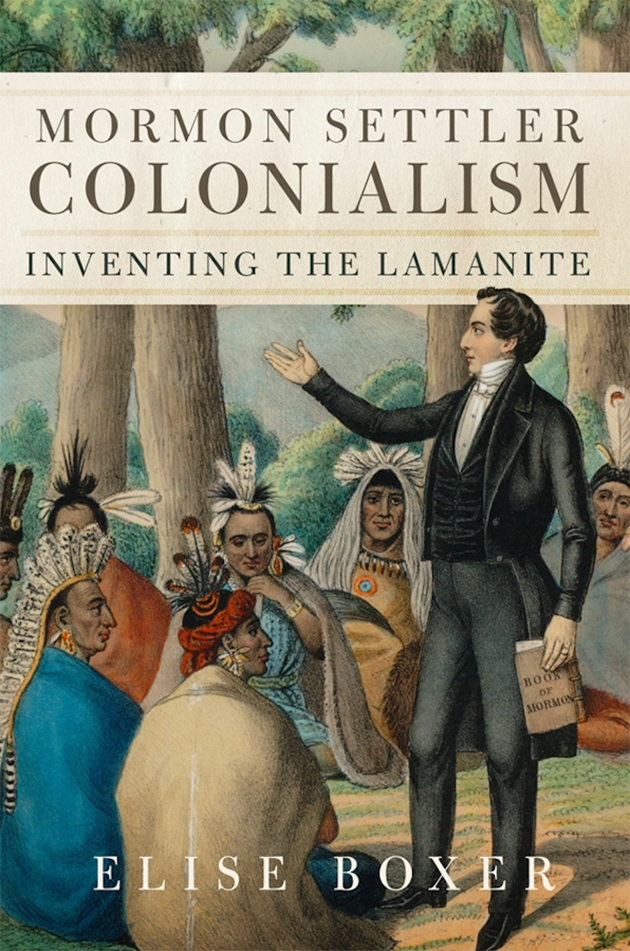
Elise Boxer, Mormon Settler Colonialism: Inventing the Lamanite, University of Oklahoma Press, 2025
According to the Book of Mormon, dissent wracked the Hebrew prophet Lehi’s family after they traveled to the Americas around 600 BC. A son, Laman, led rebellious followers who became “Lamanites,” cursed by God with a “skin of blackness.” In the nineteenth century, Joseph Smith, the first prophet of the Church of Jesus Christ of Latter-day Saints, and his followers believed Indigenous peoples to be Lamanite descendants, living in a degraded state because they no longer followed God’s commandments. In
Mormon Settler Colonialism, Elise Boxer investigates the racializing ideologies perpetuated about Indigenous peoples as a result of their categorization by Mormon doctrine as Lamanites.
Boxer uses a theoretical framework of settler colonialism—in which settlers dispossess Indigenous peoples of their lands and identity—to explore how the Mormon church has used religious doctrine to define and construct Indigeneity. She examines the development of these ideas beginning with the early-nineteenth-century establishment of the LDS Church and the publication of religious texts like the Book of Mormon, which introduced the Lamanite. Boxer explores Mormon settler colonialism beginning in the mid-1800s and investigates the Indian Student Placement Program, a foster care program that placed Indigenous children in Mormon homes during the second half of the twentieth century. Boxer argues that Mormon settler colonialism persists today, evident in the recent publication of an LDS Church manual using racialized language and contestations over the proposal to remove a mural depicting Mormon settler life in a sacred, religious structure. Boxer demonstrates how Indigenous peoples have been objects of erasure by Mormon doctrine and practices as Mormon settlers, wielding their whiteness, signaling their innocence, justifying their actions, and securing their belonging through the production of Lamanite discourse.
Although the idea of the Lamanite is foundational to Mormon discourse, the formation and dissemination of this constructed identity has not been examined in broader terms of colonialism and the cultural genocide of Indigenous peoples. This provocative book deepens the intersection of Mormonism, race (Indigeneity), and colonialism in a critical and necessary direction.